Ghost ants (Tapinoma melanocephalum) and rover ants (Brachymyrmex patagonicus) present unique structural challenges across Osceola County due to high subtropical humidity and sandy soil profiles. Standard retail…
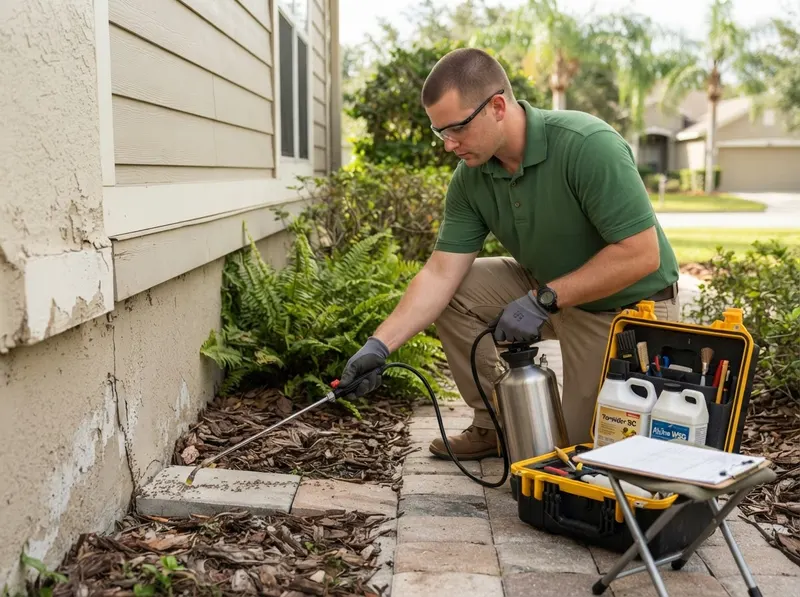
Ghost ants (Tapinoma melanocephalum) and rover ants (Brachymyrmex patagonicus) present unique structural challenges across Osceola County due to high subtropical humidity and sandy soil profiles. Standard retail contact insecticides fail against these species because contact sprays trigger a defensive biological reaction called budding. When exposed to pyrethroid sprays, a single ghost ant colony containing tens of thousands of workers and hundreds of reproductive queens will instantly fracture into three or four autonomous sub-colonies, rapidly spreading the infestation from a single kitchen backsplash into adjacent bathrooms, wall voids, and ceiling track lighting. Rover ants frequently establish dense nests within the soil of potted plants, behind electrical switch plates, and inside moisture-compromised exterior wall framing. Professional eradication requires non-repellent active ingredients and slow-acting matrix baits formulated with carbohydrate and protein attractants. Worker ants consume these undetectable agents and deliver them directly to nesting queens via trophallaxis, collapsing the entire reproductive core within 7 to 14 days.
Neighborhood conditions in Kissimmee dictate distinct harborage environments for these invasive pests. In lakefront communities such as Bellalago, Crescent Lakes, and neighborhoods bordering Lake Tohopekaliga (Lake Toho), sustained atmospheric humidity keeps perimeter turf saturated, driving ghost ants inward through window weep holes, soffits, and sliding door tracks. In high-density rental corridors like Indian Ridge and master-planned neighborhoods including Celebration and Turnberry Reserve, fast turnover and frequent irrigation cycles create ideal damp microclimates inside mulch beds, decorative stone borders, and HVAC condensation drain lines. Properties in Buenaventura Lakes (BVL), Poinciana, Mill Run, and the Kissimmee Historic District often feature mature canopy trees with branches contacting rooflines, providing arboreal foraging paths that bypass standard ground-level treatments. Effective defense couples precision indoor micro-droplet bait placements near active moisture zones with exterior non-repellent liquid perimeter bands extending 3 feet up foundation walls and 5 feet out onto adjacent soil.
Selecting colony elimination over generic interior broadcast spraying represents a calculated operational trade-off. Standard contact spraying produces a visible immediate knockdown of trailing workers within minutes, but leaves surviving underground queens intact to repopulate living areas within 3 weeks. Targeted colony elimination requires 72 to 96 hours of uninterrupted bait feeding by foraging workers before total colony collapse occurs. For short-term vacation rental operators near Old Town Kissimmee and residential homeowners alike, the sustained suppression of multi-queen reproductive structures permanently protects guest satisfaction metrics and household hygiene, establishing an unbreached perimeter without requiring ongoing monthly chemical indoor applications.
Every job gets a firm, written price after a free on-site visit.
Tell us about your ghost & rover ant colony elimination job in Kissimmee and we'll send a clear, written quote, usually the same day.
 Whitetail Pest Control