Stinging insect infestations in Central Florida accelerate rapidly between March and October due to average relative humidity exceeding 74% and daytime temperatures consistently passing 85°F. In developments like…
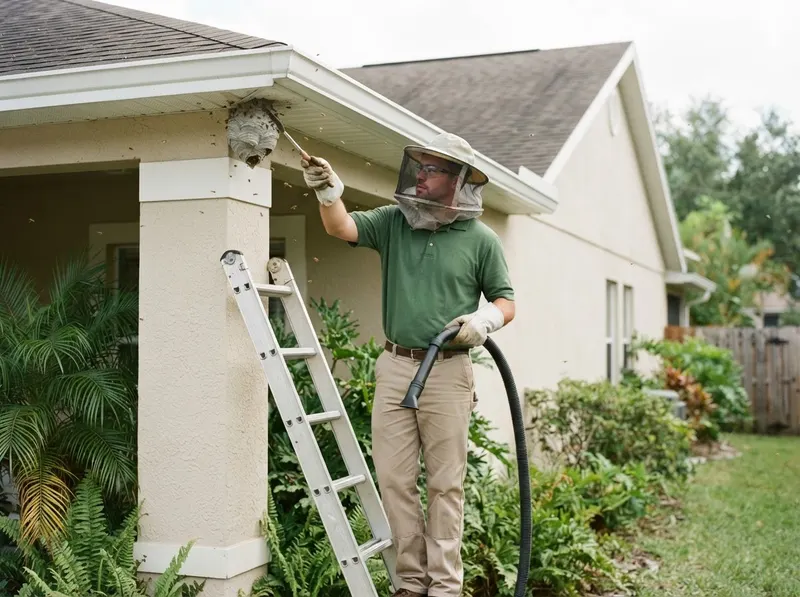
Stinging insect infestations in Central Florida accelerate rapidly between March and October due to average relative humidity exceeding 74% and daytime temperatures consistently passing 85°F. In developments like Bellalago, Crescent Lakes, and Indian Ridge, paper wasps (Polistes dominula) frequently construct open-comb hexagonal paper nests under open pool enclosure fascia, covered lanai rafters, and two-story barrel-tile roof eaves. Ground-nesting yellow jackets exploit sandy soil shifts along foundations near Shingle Creek Regional Park and Lake Tohopekaliga, establishing subterranean colonies containing 1,500 to 4,000 workers that trigger defensive swarm attacks when vibrations from lawn equipment disrupt the colony perimeter.
Effective structural removal replaces retail aerosol sprays with targeted, high-reach application equipment and microencapsulated residual formulations. Standard consumer sprays wash away under frequent Osceola County afternoon thunderstorms, leaving residual pheromones that attract returning forager wasps back to the identical framing site within 48 to 72 hours. In historical properties throughout the Kissimmee Historic District, yellow jackets and bald-faced hornets routinely penetrate weeping mortar lines, loose cedar siding, or unsealed gable attic louvers, requiring void-injection pyrethroid dust treatments directly into wall cavities rather than generic perimeter surface spraying.
Short-term vacation rental owners in communities like Celebration and Turnberry Reserve face severe listing cancellation risks when stinging insects cluster around pool heating units, patio dining enclosures, or main entryway fixtures. 1. Inspection: A technician isolates the active entry point, identifies the exact stinging species, and assesses structural depth across rooflines, soffits, and wall joints. 2. Knockdown: An aerosolized or precision liquid formulation neutralizes active guard wasps within 30 to 60 seconds to halt defense pheromone dispersal. 3. Physical Removal: Technicians scrape away the primary paper or mud comb, de-anchoring the pedicle attachment from structural framing. 4. Residual Defense: An exterior water-resistant barrier is applied to the bare substrate to neutralize returning field foragers and deter seasonal re-nesting on treated structural surfaces.
Every job gets a firm, written price after a free on-site visit.
Tell us about your wasps & stinging insect nest removal job in Kissimmee and we'll send a clear, written quote, usually the same day.
 Whitetail Pest Control